
How a holiday-house move on the Mornington Peninsula actually works
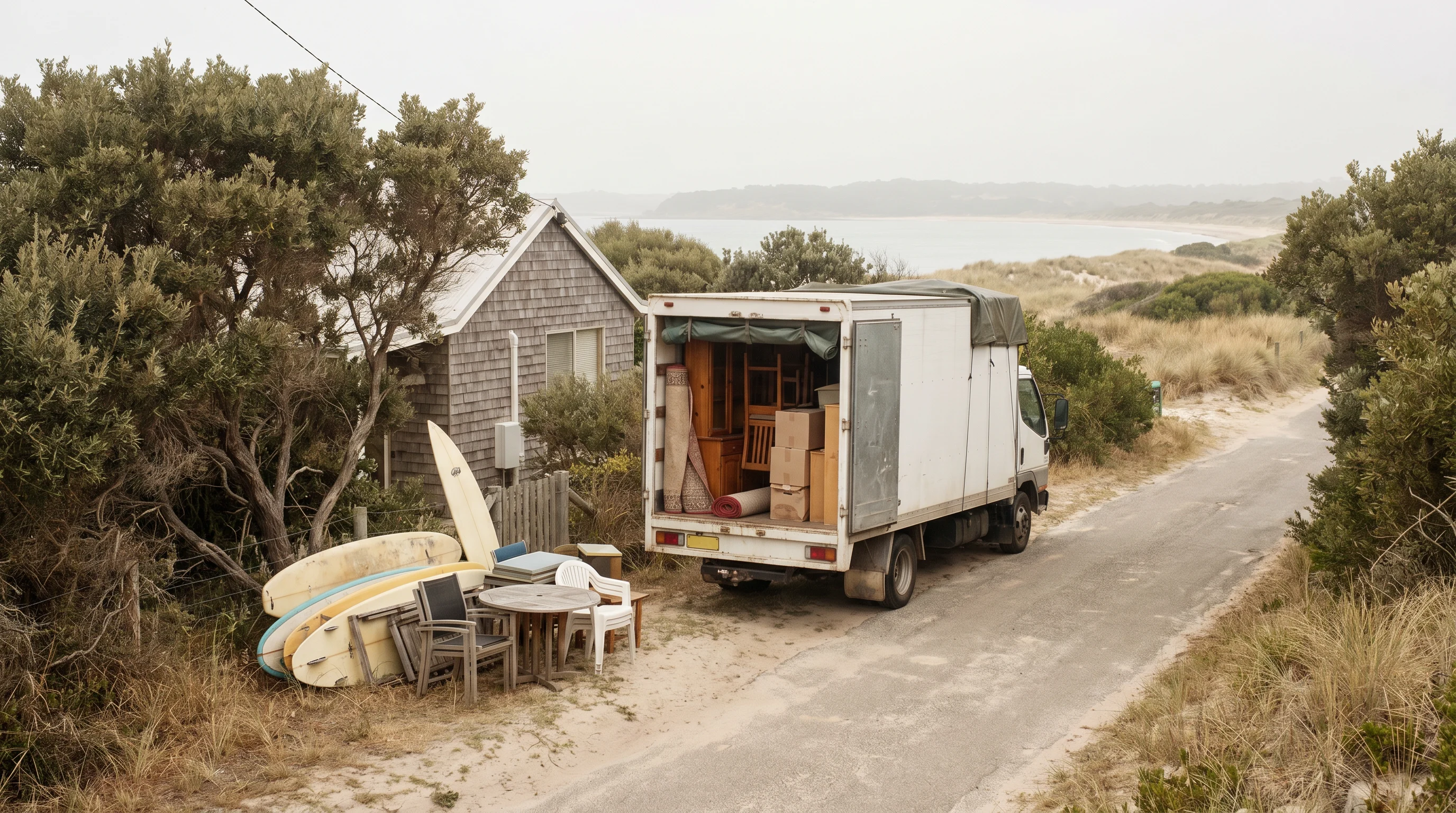
If you are moving on the Mornington Peninsula, it helps to think about your move as two separate problems that get solved together: the journey and the property. Almost every move down here is shaped by one or both, and the homes that fill the Peninsula, holiday houses, sea-change family homes, and the run back to Melbourne, make it different from a straightforward suburban move in the city.
The journey: the long haul up and down Peninsula Link
Unless you are moving from one Peninsula suburb to another, your move involves the corridor to Melbourne. From the Melbourne end at Mount Eliza it is roughly an hour; from the tip at Sorrento or Portsea it is closer to an hour and a half each way. That distance is a real cost in a move, because it decides whether a dedicated truck or a backload makes more sense.
A dedicated truck carries your whole home in one run on a fixed schedule, which suits a full household and firm dates. A backload shares truck space with another move travelling the same corridor, which is cheaper and ideal for a part-load, provided you have a little flexibility on timing. For most holiday-house moves, a backload is the smarter option.
The property: access decides the truck and the crew
The second problem is getting in and out of the property itself, and the Peninsula throws up some genuinely tricky access:
- Sandy tea-tree lanes near the tip, around Rye and Blairgowrie, can be soft and narrow, so a big truck sometimes cannot get in.
- Cliff-top drives in Portsea are long, steep and private, and a large truck usually cannot get close to the house.
- Acreage and hinterland blocks behind Dromana and Mount Martha have gates, gravel drives and limited turning room.
- Tight heritage villages like Sorrento have scarce parking that gets worse in summer.
Where access is hard, the answer is a shuttle vehicle: park the big truck somewhere legal and safe, and ferry the load the last leg in something smaller. The key is to plan it before the day, not discover it when the truck arrives.
The load: a holiday house is usually a part-load
A holiday house is rarely a full household. More often it is a part-load coming down from town to set up a weekender, or a pack-down at the end of a season. That matters because it changes the size of the job: a smaller crew, less truck space, and, on the long haul, a strong candidate for a backload. There is no point paying for a four-mover, two-truck crew to move a few rooms.
Timing: mind the summer peak
From December to late January the Peninsula is at its busiest. The holiday towns fill up, village parking disappears, the lanes near the tip are crowded, and removalists book out. If your dates are flexible, an off-peak move is easier, cheaper to schedule, and gives the crew a clearer run. If you do need a summer move, plan the timing and the loading spot more carefully and book early.
Putting it together
The neat thing about treating your move as a journey plus a property is that the two plans inform each other. A part-load to a cliff-top Portsea house with flexible dates points to a backload plus a shuttle; a full sea-change into a flat Safety Beach home on a fixed settlement date points to a dedicated truck and a straightforward carry. Work both out up front and the day runs to a plan.
If you would like to see how it works for your move, the Peninsula Move Planner walks through it in a minute, or you can get a no-obligation quote and we will plan it with you.
Common questions
Is a holiday-house move cheaper than a full house move?
Usually, because it is a part-load rather than a whole household, so it needs less truck space and a smaller crew. On the long haul to or from Melbourne, a part-load is also ideal for a backload, which shares truck space with another move along the corridor and keeps the price down, especially if your dates are flexible.
When is the best time of year to move on the Peninsula?
Outside the summer holiday peak if you can. From around December to late January the bay towns are full, parking is scarce in villages like Sorrento and Rosebud, and the sandy lanes near the tip are busy, so a move is slower and trickier to schedule. An off-peak move gives the crew a clearer run.
Can a removal truck reach a clifftop or tea-tree-lane property?
Often not directly. On the Portsea cliffs and the soft, narrow lanes near the tip, a large truck cannot get to the door, so the realistic approach is to park it where it can safely sit and run a smaller shuttle vehicle for the last leg. That is planned before move day, not discovered on it.
Planning a move?
Get a free, no-obligation quote and we'll plan the access at both ends with you.
Get a quote